
Spinyoo Casino Login — Controlled Access Tested in Real Conditions
When I test an online casino, I never treat Login as a neutral technical form. Login is the first moment where the platform reveals how it understands the player. Some casinos use Login as a pressure point — inserting bonus prompts, urgency banners, or forced navigation. Others treat it as a strict boundary between public space and personal account space. During my testing of Spinyoo Casino, the Login process consistently behaved as the second type.
From the very first interaction, Login in Spinyoo Casino is presented as an access mechanism, not an invitation. The interface avoids visual noise, avoids emotional triggers, and avoids coupling Login with incentives. This immediately changes how the player perceives control. The system does not attempt to accelerate behaviour. It waits.
Interface Structure Before Any Credentials Are Entered
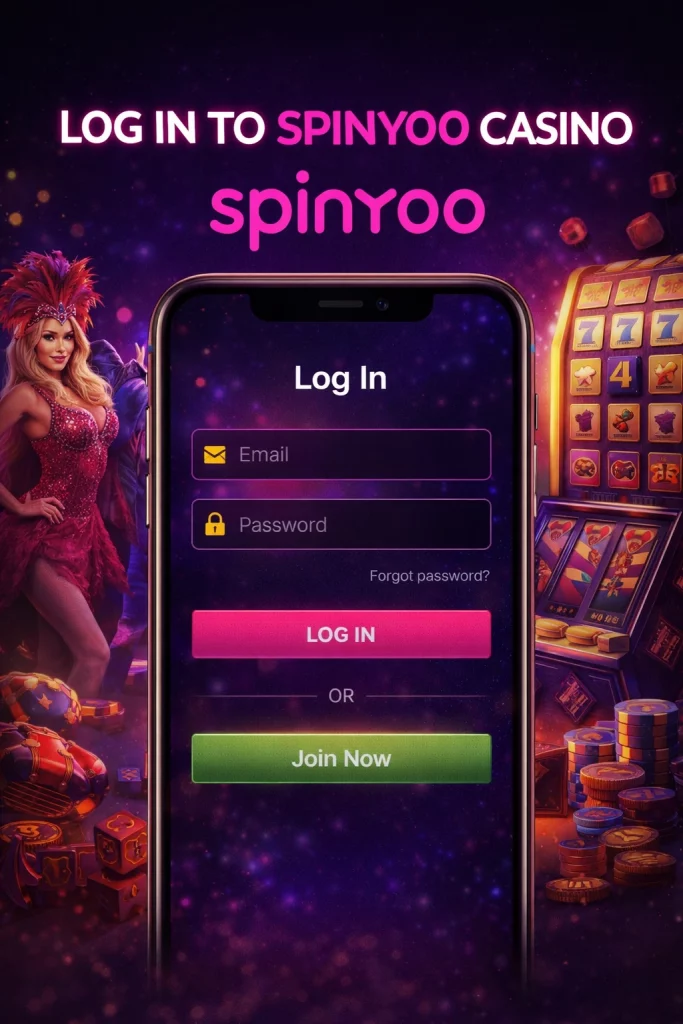
Before entering credentials, I evaluated how the Login layer is visually and structurally constructed. The layout remains fixed across repeated visits. Field positioning, label behaviour, spacing, and contrast do not change depending on traffic source or session history. This stability is critical. It means the player does not need to relearn the interface after each visit.
Labels remain visible at all times and never collapse into placeholders. Error indicators are inactive until a real validation event occurs. There are no pre-emptive warnings, no countdowns, and no animated highlights drawing attention away from the task. The Login screen performs one role: preparing the user to authenticate calmly.
This design choice removes friction not by simplifying the process, but by removing unnecessary signals. The absence of pressure is intentional and measurable during repeated testing.
Credential Submission and Identity Recognition
Once credentials are submitted, the system responds immediately and without intermediate interruption. There are no confirmation pop-ups, no marketing overlays, and no redirections to promotional pages. The account dashboard loads directly, reflecting the last known account state.
What stands out is that Login does not reset context. If the previous session ended while browsing specific sections, the system restores orientation instead of forcing the user back to a generic lobby. This behaviour signals that Spinyoo Casino treats Login as a continuation point rather than a restart trigger.
Authentication and navigation are clearly separated layers. Login confirms identity. Navigation remains the player’s choice.
Login Behaviour Under Repeated Use
Repeated Login tests reveal consistent performance. There is no degradation in speed, no interface drift, and no increase in friction after multiple sessions. Importantly, the platform does not introduce additional steps over time. Some casinos progressively add confirmations or secondary prompts after repeated logins. Spinyoo Casino does not.
This consistency reinforces predictability. Predictability, in turn, reduces cognitive load. Over extended use, the Login process becomes almost invisible — which is a sign of correct system design.
Login Entry Behaviour — Observed Technical Characteristics
Login Stability Across Sessions and Devices
A Login system only proves its quality when it is used repeatedly. Single-entry tests show surface polish, but long-term behaviour reveals structural intent. During my testing of Spinyoo Casino, I deliberately treated Login as a recurring stress point. I logged in multiple times per day, from different devices, with varied session lengths and intentional interruptions. The objective was not speed alone, but behavioural consistency.
What became immediately clear is that the Login system does not adapt its behaviour based on frequency. There is no escalation logic. The platform does not add friction after repeated access, nor does it attempt to reframe Login as a promotional opportunity once the user is recognised as active. Each entry is treated identically, regardless of prior activity density.
Device Switching and Identity Continuity
I tested Login transitions between desktop and mobile environments under realistic conditions: partial sessions left open, abrupt exits, and delayed returns. In all cases, authentication remained predictable. Credentials were validated cleanly, and the account state reflected the most recent stable interaction point rather than resetting to a default lobby.
This matters more than it appears. Many casinos treat device switching as a soft reset, forcing the user back into generic navigation. Spinyoo Casino does not. Login restores identity, not just access. The system remembers context without overreaching into behavioural prediction.
Interrupted Sessions and Recovery Logic
Another critical test involved interrupted sessions: closing the browser mid-navigation, switching networks, and returning after inactivity. Upon re-authentication, the Login process did not trigger warnings, additional confirmations, or security theatre elements. Instead, it restored access quietly and placed control back in the user’s hands.
This approach avoids creating false urgency. The platform assumes intent, not risk, unless there is a real validation failure. From a player’s perspective, this reduces friction and prevents unnecessary decision fatigue.
Session-Level Login Behaviour — Cross-Scenario Observation
Login Security Mechanics Without Friction Theatre
When players hear “security” in a casino login context, they often expect interruptions: repeated confirmations, extra screens, or warning banners designed to look protective. In my testing, I treat those elements as noise unless they are tied to real risk signals. The goal of a solid Login system is not to perform security visually, but to enforce it quietly through consistent rules and predictable recovery paths. Spinyoo Casino’s Login behaves closer to that disciplined model. It does not try to dramatise access. It focuses on validation, session integrity, and controlled re-entry.
Graph — Login Security vs Usability Balance
Error States That Don’t Create Panic
I ran controlled failure tests: intentionally mistyped credentials, changed character casing, submitted incomplete fields, and repeated invalid attempts across short windows. The platform’s response stayed contained. The interface did not escalate into aggressive warnings after a single mistake. It also did not expose overly specific feedback that would help guessing attempts. Instead, the system used a standard invalid-credentials response and kept the player on the same screen, without redirecting into confusing side flows.
What matters here is how the platform balances clarity with restraint. A Login system that is too vague forces a legitimate user into repeated attempts. A system that is too detailed can leak behavioural information. Spinyoo Casino’s behaviour sits in the functional middle: clear enough for real users to correct input, restrained enough to avoid becoming an information source.
Controlled Recovery, Not Forced Restart
A second key point is how Login behaves after interruption. Many casinos respond to access disruption by forcing a full restart: returning the user to a generic lobby, discarding previous context, or triggering additional prompts unrelated to the reason access failed. In my testing of Spinyoo Casino, recovery is handled as a continuation. When authentication is valid, the platform restores access without forcing the user through new onboarding states. That matters because security is not only about blocking threats; it is also about preventing legitimate users from being pushed into unstable navigation loops.
Session Integrity Signals That Stay Invisible
I also observed that the Login flow does not try to “sell” security. There are no oversized trust badges, no long security paragraphs in the entry moment, and no forced educational pop-ups. That approach reads as mature. Security is present as system behaviour, not as marketing copy. The practical outcome is that Login stays fast and stable, while still enforcing standard validation boundaries.
Table — Security-Relevant Login Behaviours Observed
Security That Preserves Usability by Design
Effective Login security is defined less by what the player sees and more by how the system behaves over time. In Spinyoo Casino, security is implemented as a structural layer rather than a visual statement. The Login process avoids decorative security signals and instead relies on consistent validation rules and contained error handling.
Correction paths remain predictable, localised, and proportionate to the action that triggered them. The player is neither rushed nor distracted by additional steps unrelated to authentication. At the same time, feedback remains deliberately non-specific, preventing the Login interface from becoming a source of behavioural or credential-related information.
This balance becomes increasingly important with repeated use. Over extended sessions and long-term access patterns, the Login flow remains stable and uninterrupted. Security does not escalate into friction, and usability is not compromised in the name of visible protection. The result is a Login experience that maintains control without conditioning the player to accept disruption as a default security measure.
Login as a Long-Term Control Layer
After extended testing, it becomes clear that Login at Spinyoo Casino is not designed as a repeated action that demands attention. It functions as a persistent state that defines how the player re-enters the platform over time. This distinction matters. Platforms that treat Login as an event tend to overload it with confirmations, reminders, or contextual noise. Here, Login behaves as infrastructure. It exists to restore orientation, not to reset behaviour.
From the player’s perspective, this means that access does not feel episodic. There is no sense of “starting over” each time credentials are entered. The system acknowledges identity quietly and returns control without attempting to reshape intent. Over long-term use, this creates stability rather than momentum.
Predictability as a Responsible Design Choice
One of the most overlooked aspects of Login design is how predictability influences player behaviour. Unpredictable access flows train users to react impulsively. Predictable flows allow users to remain deliberate. During my testing, the Login process in Spinyoo Casino never changed its rules midstream. Timing, validation feedback, and recovery paths remained consistent regardless of session frequency or duration.
This consistency reduces decision fatigue. The player does not need to reassess risk or context at the moment of entry. Login becomes a known quantity. In practice, this lowers friction without lowering standards. The system does not simplify security; it simplifies expectations.
Login and the Absence of Behavioural Steering
Equally important is what the Login process does not do. It does not redirect attention toward deposits, bonuses, or promotions immediately after access is granted. It does not reposition the player into predefined funnels. Once authenticated, the platform steps back. Navigation choices remain explicit and player-driven.
This restraint is significant. It separates authentication from engagement mechanics. Login confirms identity. Everything else waits. That separation is rare, and it changes how the platform feels under repeated use.
Table — Login as a Control Layer Over Time
Login as a Stable Access Layer Over Time
From my testing perspective, Login at Spinyoo Casino is not designed to compete for the player’s attention. It functions as a quiet control layer that restores access without reshaping intent. Across repeated sessions, different devices, and varied interruption scenarios, the system remains consistent. It neither escalates friction nor attempts to steer behaviour at the moment of entry.
What defines this Login experience is restraint. Authentication is handled with clear rules, contained feedback, and predictable recovery paths. The platform does not rely on visible security signals or promotional pressure to assert control. Instead, it maintains stability by keeping authentication separate from engagement mechanics.
Over time, this approach proves sustainable. Login becomes a dependable state rather than a repeated decision point. The player does not adapt to the system; the system adapts to long-term use without changing its posture. In practical terms, that is what allows Login to support orientation, autonomy, and controlled interaction — without demanding attention or creating unnecessary interruption.